
AKD Surface Sizing Agent · Papermaking
From the sizing kitchen to the dried sheet
An AKD surface sizing agent is commonly applied with starch to improve paper water resistance. Starch forms the main film on the paper surface, while AKD contributes hydrophobic character.
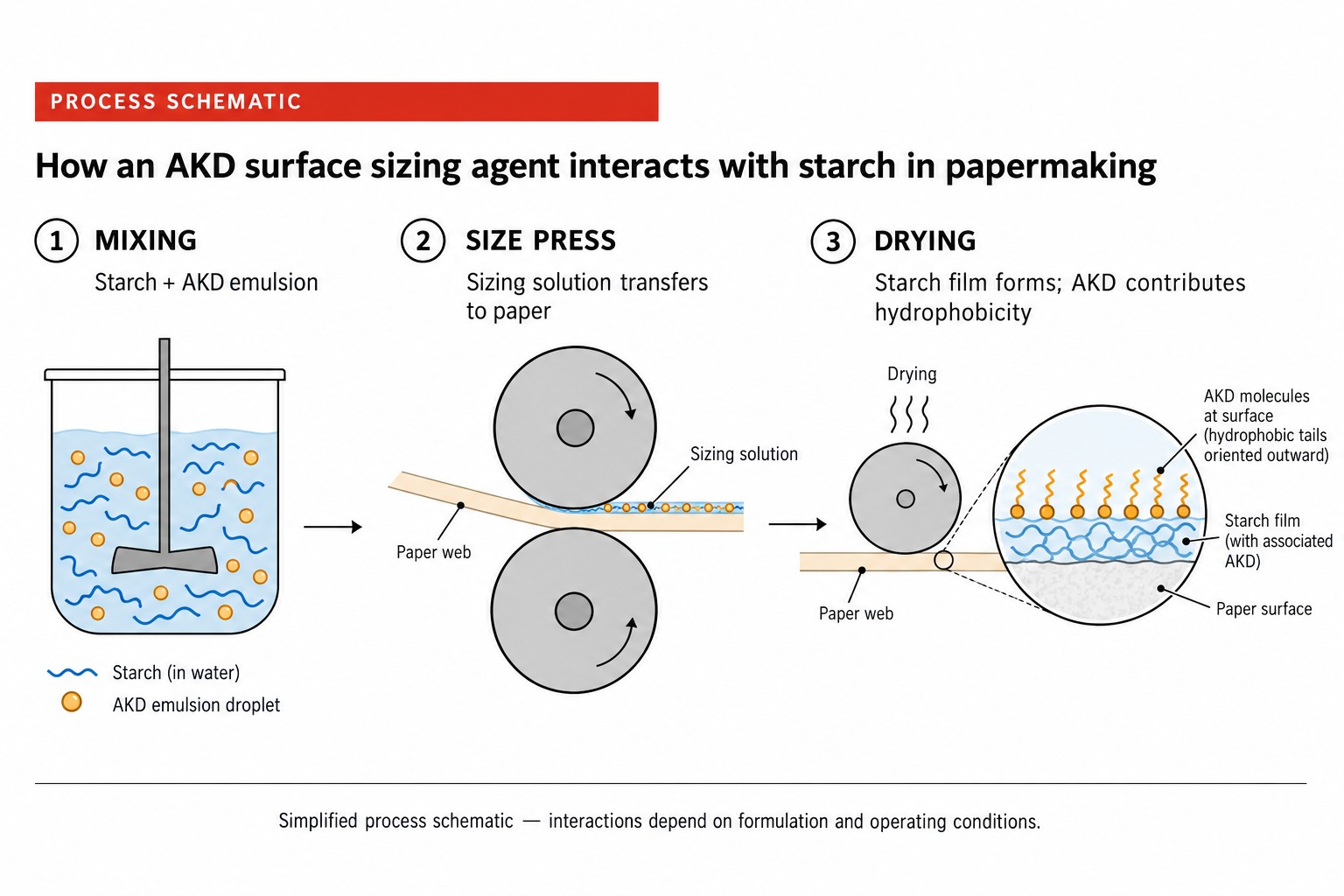
Their combined effect develops through formulation preparation, transfer at the size press, and drying. It is best understood as a process interaction—not as a simple direct reaction between starch and AKD.
1. Mixing: AKD emulsion is blended into the starch solution
In a starch-based surface sizing formulation, cooked or prepared starch provides the continuous liquid phase and the film-forming component. The AKD surface sizing agent is supplied as an aqueous emulsion, with its particles dispersed in water and stabilized by the formulation’s emulsifying system.
When the AKD emulsion is added under suitable mixing conditions, the goal is to distribute it evenly through the starch solution while maintaining emulsion stability. The starch does not normally need to chemically react with AKD in the mixing tank. Instead, starch helps form a workable sizing solution that can carry the dispersed AKD to the paper surface.
Compatibility depends on the particular AKD emulsion, starch type and cooking conditions, solids content, temperature, pH, water quality, and mixing sequence. A formulation should be checked for stability and runnability before mill use.
2. Size press: starch helps transfer AKD to the paper
At the size press, the starch-and-AKD solution is applied to the moving paper web as it passes through the rolls. The starch solution controls important application properties, including viscosity and film formation, and helps distribute the AKD emulsion across the sheet.
Some of the sizing solution remains near the surface, while some may penetrate into the sheet. The actual transfer and penetration depend on paper absorbency, web moisture, nip conditions, solution properties, and machine speed. This stage therefore determines how evenly the starch film and AKD are delivered to the paper.
3. Drying: the starch film forms and AKD contributes hydrophobicity
As water is removed in the dryers, starch concentrates and forms a film that binds the surface and helps hold the applied sizing components in place. Meanwhile, AKD becomes distributed within or near this starch-rich layer. Its hydrophobic alkyl groups contribute to resistance to water wetting and penetration.
The final sizing response develops as the sheet dries and may continue to mature after application, depending on the AKD product and process conditions. This does not imply a direct covalent bond between starch and AKD; the result depends on the specific formulation and operating conditions.
A Combined Effect
In starch-based surface sizing, starch mainly provides the carrier and film-forming matrix, while the AKD surface sizing agent contributes hydrophobicity. The performance of the combined system depends on emulsion compatibility, application quality, drying conditions, and the paper grade’s requirements.
Discuss your surface sizing application
Share your paper grade, starch system, and size press conditions with Aupha Chem.